Showing posts with label John Ruskin. Show all posts

Wednesday, 3 September 2014

Architecture in Renaissance painting: notes from the National Gallery

Portrait of a man in armour /Francesco Granacci (c1469-1543). The landscape beyond his shoulder creates actuality/realness.

Arches, archways, openings and doorways are architectural forms of greetings - and entrances.

Virgin - porta coeli.
Doorways that lead to heaven.
Indoor space is a focus for intimacy.
By 1420. artists began to explore new kinds of interior.
Inventing places was as fundamental as inventing figures.
Nativity/Ercole de' Roberti

Adoration of the Kings/Botticelli

Virgin Adoring the Infant Christ/Andrea del Verrocchio. John Ruskin described this painting as 'an entirely priceless example of excellent painting, exemplary for all time'.

Sunday, 27 April 2014

Don't put in meaningless lines

Reading Fugitive Pieces/Ann Michaels which comes highly recommended ... but is not gripping me. It seems crafted - over-researched and over-wrought - striving for effect.

Pleased to see an early mention of Edward Wilson who was with Scott as surgeon and naturalist on the Discovery and Terra Nova.  He catalogued the journey and his discoveries by painting and drawing (having read Natural Sciences at Cambridge and studied medicine at St George's, London).  His watercolours are highly skilled and scientifically accurate - precise colours reflecting atmospheric conditions.
Seeing precisely: back to Ruskin and his exhortations to the traveller to really look at what is around him.


Ruskin - admired greatly by Wilson -  thought anyone was able to draw. It doesn't matter how well. Simply the attempt to describe - regardless of talent - is admirable. Drawing can teach you to see, not just look.
"There is a satisfactory and available power in everyone to learn drawing if he wishes, just as early all persons have the power of learning French, Latin or arithmetic, in a decent and useful degree." 
In Scott's Journals (May 1911) Wilson himself entertained the party with a lecture on sketching.

"He started by explaining his methods of rough sketch and written colour record, and explained its suitability to this climate as opposed to coloured chalks etc - a very practical method for cold fingers an one that becomes more accurate with practice in observation. His theme then became the extreme importance of accuracy, his mode of expression and explanation frankly Ruskinesque. Don't put in meaningless lines - every line should be from observation. So with contrast of light and shade-  find shading subtle distinction, everything - impossible, without care, patience and trained attention."

'Don't put in meaningless lines': today's 'Thought for the Day'.
Scott closes the diary entry that day with a few words of praise....:
"The lecture was delivered in the author's usual modest strain, but unconsciously it was expressive of himself and his whole-hearted thoroughness. He stands very high in the scale of human beings - how high I scarcely knew until the experience of the past few months. ....
The achievement of a great result by patient work is the best possible object-lesson for struggling humanity, for the results of genius, however admirable, can rarely be instructive. The chief of the Scientific Staff sets an example which is more potent than any other factor in attaining that bond of good fellowship which is the marked and beneficent characteristic of our community."


Wednesday, 16 April 2014

Tricky translations and insights from Ruskin

The possibility of disillusion threatening to be a theme of the week: ridiculous as it is a sunny, exhilarating Easter Week. But it did come up in passing when thinking about anticipation yesterday: disappointment is always a possibility i.e. actually seeing things as they are.

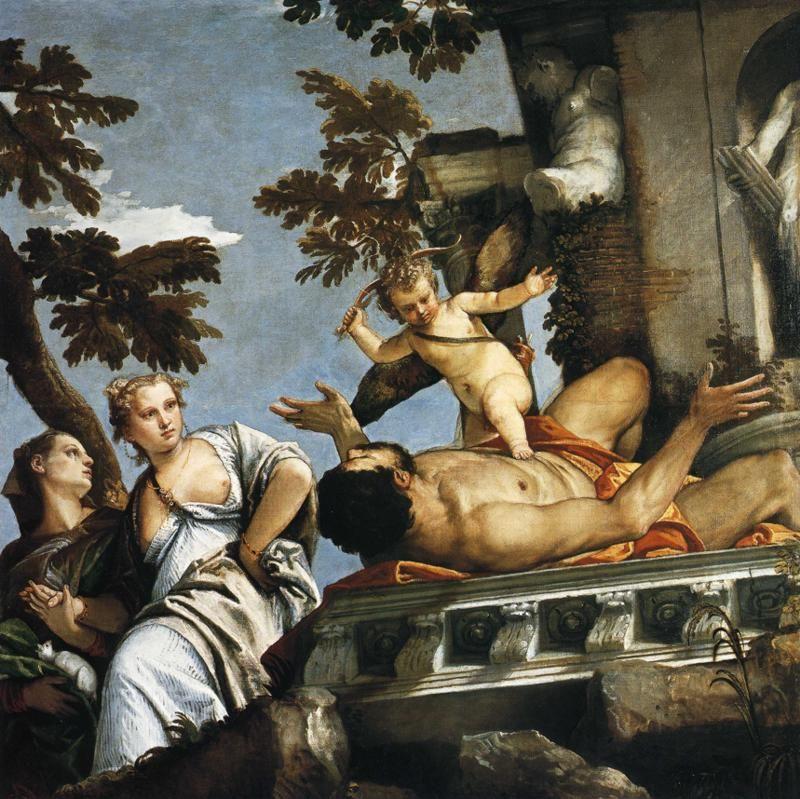
There are - apparently - difficulties in translating 'Disinganno', the title of one of Veronese's Allegories of Love in the National Gallery (which displays it as 'Scorn').  T.J. Clark in the London Review of Books questions this. He says there is more disillusion and dispiriting eye-opening than 'scorn' in 'disinganno'. Love the idea that this is a Baroque term: what exactly does that mean?
"The English Scorn, which has come to be attached to it, is surely wrong, both visually and in terms of philology. Disinganno is a strong Baroque term. It is the moment of being robbed of one's illusions and seeing the actual state of things. There is an element of chastisement and self-chastisement to it, and certainly an element of stripping to the bone. 'Disabuse' is as close as we can come to the idea in English, but the word is too weak, too awkward. In this case, the Italian should stand."  
Veronese was Ruskin's favourite painter.
Ruskin himself turned to words: word pictures, as he called them - the intent to describe a scene in words as accurately (perhaps more vividly) than by drawing.  His description of S. Marco so precise that it awes.  His art is just as intricate: he felt he could possess an object in some way by drawing it.


Very interesting ideas, too, on how to travel. As a child, he travelled with his family around Britain and mainland Europe - to the Alps, the medieval cities of France and Italy, in particular Amiens and Venice.  They journeyed slowly in a coach, never more than 50 miles a day and every few miles stopped to admire the scenery. Ruskin did this for the rest of his life.

For this reason, he deplored the haste of tourists who cover Europe in a week by train (apparently Thomas Cook first offered this in 1862.)

"No changing of place at a hundred miles an hour will make us one whit stronger, happier, or wiser. There was always more in the world than men could see, walked they ever so slowly; the will see it no better for going fast. The really precious things are thought and sight, not pace. It does a bullet no good to go fast and a man, if he be truly a man, no harm to go slow; for his glory is not at all in going, but in being."
Back to mindfulness.

Tuesday, 18 March 2014

Breakfast in mist and a visit to St Mark's Basilica

A news flash came through last night on my iPad: L'Wren Scott hanged herself - apparently - in her flat in Manhattan from a door knob with a scarf of her own design. Truly awful: and somehow, one fears, something to do with the corrosive power of celebrity and the rottenness of celebrity. Mick Jagger, who apparently didn't refer to her as his girlfriend but 'someone I'm seeing' - the eternal adolescent.

I am staying at the Pension Calcina, where Ruskin apparently penned Stones of Venice.

The morning is misty: there is excellent red currant jam. The taste reminds me of home.
There are fat pink carnations by the church candles on the breakfast table, but I can't really take a picture.

Read Ruskin in preparation for St Mark's: have avoided it up to now - too many tourists. But I am one, after all - and after the mosaics in Ravenna I can hardly ignore it.  Step away, says Ruskin, from the dark
flag-stoned cathedral close of the English shires to the Byzantine wonders of Venice.

"... there arrives a great vision out of the earth, and all the great square seems to have opened from it in a kind of awe, that we may see it far away; a multitude of pillars and white domes, clustered into a long low pyramid of coloured light; a treasure-heap, it seems, partly of gold, and partly of opal and mother-of-pearl, hollowed beneath into five great vaulted porches, ceiled with fair mosaic, and beset with sculpture of alabaster, clear as amber and delicate as ivory - sculpture fantastic and involved, of palm leaves and lilies, and grapes and pomegranate, and birds clinging and fluttering among the branches all twined together into an endless network of buds and plumes; and, in the midst of it, the solemn forms of angels, sceptred and robed to the feet and leaning to each other across the gates... And around the walls of the porches there are set pillars of variegated stones, jasper and porphyry and deep-green serpentine spotted with flakes of snow, and marbles, that half refuse and half yield to the sunshine....."

Such prose!
Mary McCarthy notes that some people, on hearing that she has an assignment to write about Venice, say - how lucky! Those are the uninitiated. Those who know - how much has been written -  realise how difficult it is  - and are slightly more cautious in their congratulations. So much has already been said.

NOTE
Ruskin, by the way, loves the mosaics. He feels that they are truer in their purpose than some of the great Renaissance art - where we wonder at the painter's skill, rather than his religious feeling.


Saturday, 15 March 2014

Notes on travel: why travel at all?

An interesting conversation at breakfast with my host. What would I want in a rented flat? He is just furnishing one to let (short term to tourists.) Would I want a home cinema? (When we say 'home cinema' , we mean a television with a DVD player). Would I want DVDs? What kitchen equipment would I like? Would I prefer a shower or a bath? Some people prefer showers because they don't want to think about lying around in water in a place where other people have bathed.
People now expect - apparently - home from home. Or to judge from TripAdvisor, even more than home from home. What is the point of travel? If you just flop in front of a DVD at the end of the day? Shouldn't it really be something else - to open up new vistas and new thoughts?
On this trip have not bought a return ticket. Know that I have to be back at work on a certain date. But otherwise everything is up in the air.
I have realised that I have forgotten a few things i.e. stuff to clean glasses with, and a nail scissors.
A pencil sharpener would have been very useful, as would small (very light weight) binoculars, and a camera with a zoom. (The only camera is on my mobile phone and the zoom is hopeless).
Why did Byron travel? Melancholy, says Thomas Moore. "... to have, at once, anticipated the worst experience both of the voluptuary and the reasoner - to have reached, as he supposed, the boundary of this world's pleasures, and see nothing but 'clouds and darkness' beyond, was the doom, the anomalous doom, which a nature, premature in all its passions and powers, inflicted on Lord Byron... Such was the state of mind and hear t- as from his own testimony and that of others, I have collected it - in which Lord Byron now set out on his definite pilgrimage...."
John Ruskin/Stones of Venice would be spinning in his grave were he to think of flats in Venice with home cinemas - 'home from home'.
"In the olden days of travelling, now to return no more, in which distance could not be vanquished without toil, but in which that toil was rewarded partly by the power of deliberate survey of the countries through which the journey lay, and partly by the happiness of the evening hours, when from the top of the last hill to be surmounted, the travelled beheld the quiet village where he was to rest, scattered amongst the valley stream.... in those days, I say, when there was something more to be anticipated andremembered in the first aspect of each successive halting place, than an arrangement of glass roofing and iron girders..."
Railway stations, he means, of course. But stations have their own magic.


Reading and watching

  • Foot by Foot to Santiago de Compostela/Judy Foot
  • The Testament of Mary with Fiona Shaw at the Barbican
  • The Testament of Mary/Colm Toibin
  • Schwanengesang/Schubert - Tony Spence
  • Journals/Robert Falcon Scott
  • Fugitive Pieces/Ann Michaels
  • Unless/Carol Shields
  • Faust/Royal Opera House
  • The Art of Travel/Alain de Botton
  • Mad Men Series 6
  • A Week at The Airport/Alain de Botton
  • The Railway Man/Eric Lomax
  • Bright Lights, Big City/Jay McInerney
  • Stones of Venice/John Ruskin
  • The Sea, the Sea/Iris Murdoch
  • Childe Harold/Lord Byron
  • All The Pretty Horses/Cormac McCarthy
  • Extreme Rambling/Mark Thomas
  • Story of my Life/Jay McInerney
  • Venice Observed/Mary McCarthy