Showing posts with label National Gallery. Show all posts

Wednesday, 16 April 2014

Tricky translations and insights from Ruskin

The possibility of disillusion threatening to be a theme of the week: ridiculous as it is a sunny, exhilarating Easter Week. But it did come up in passing when thinking about anticipation yesterday: disappointment is always a possibility i.e. actually seeing things as they are.

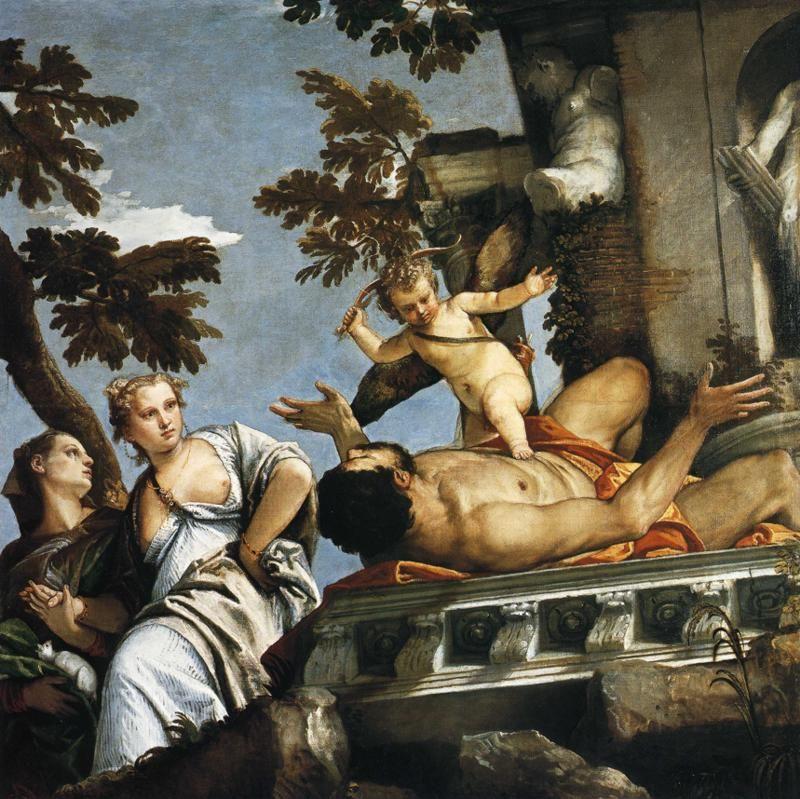
There are - apparently - difficulties in translating 'Disinganno', the title of one of Veronese's Allegories of Love in the National Gallery (which displays it as 'Scorn').  T.J. Clark in the London Review of Books questions this. He says there is more disillusion and dispiriting eye-opening than 'scorn' in 'disinganno'. Love the idea that this is a Baroque term: what exactly does that mean?
"The English Scorn, which has come to be attached to it, is surely wrong, both visually and in terms of philology. Disinganno is a strong Baroque term. It is the moment of being robbed of one's illusions and seeing the actual state of things. There is an element of chastisement and self-chastisement to it, and certainly an element of stripping to the bone. 'Disabuse' is as close as we can come to the idea in English, but the word is too weak, too awkward. In this case, the Italian should stand."  
Veronese was Ruskin's favourite painter.
Ruskin himself turned to words: word pictures, as he called them - the intent to describe a scene in words as accurately (perhaps more vividly) than by drawing.  His description of S. Marco so precise that it awes.  His art is just as intricate: he felt he could possess an object in some way by drawing it.


Very interesting ideas, too, on how to travel. As a child, he travelled with his family around Britain and mainland Europe - to the Alps, the medieval cities of France and Italy, in particular Amiens and Venice.  They journeyed slowly in a coach, never more than 50 miles a day and every few miles stopped to admire the scenery. Ruskin did this for the rest of his life.

For this reason, he deplored the haste of tourists who cover Europe in a week by train (apparently Thomas Cook first offered this in 1862.)

"No changing of place at a hundred miles an hour will make us one whit stronger, happier, or wiser. There was always more in the world than men could see, walked they ever so slowly; the will see it no better for going fast. The really precious things are thought and sight, not pace. It does a bullet no good to go fast and a man, if he be truly a man, no harm to go slow; for his glory is not at all in going, but in being."
Back to mindfulness.

Tuesday, 18 March 2014

A last minute trip to the Accademia

I am one of the National Gallery's most frequent visitors ( a bold claim) - but I work on Leicester Square and it would seem a near criminal oversight not to call in at lunchtimes. 
So I left the Accademia until last in Venice - I didn't feel like going to a museum. I even bought a ticket after 6pm and calculated on 45 minutes to see all before closing time (after an drink on the rooftop balcony at the hotel).
Thank goodness I went.
Otherwise would not have seen some important paintings: The Dream of Ursula/Carpaccio - John Ruskin's favourite painting, I read - more to research later .... an odd favourite, it seems to me.

 
And Tintoretto's St Mark's Body brought to Venice.


Monday, 6 January 2014

Dismantling a wall and diversions on Uxbridge Road

They are dismantling the Wall at St James's Piccadilly - pass by on my way to NatWest at lunchtime to pay in a cheque. Am sorry that I missed this but also sorry somehow that it happened. Cannot believe that presenting such a visual symbol of conflict in such a way can result in any good.
Lucy Winkett (Rector of St James's) is a role model of mine but she seems defensive in the Guardian.
"When we have been challenged about "taking sides" and "politicising the church" – which is a fair discussion to have – we are clear that we are not "pro" one side or another but we are instead campaigning for equal human rights for all people regardless of ethnicity or background. Sometimes the church will speak on issues seen as political in order to advocate for people who are suffering. We are supporting the ordinary people of Bethlehem at Christmas because we believe it would be wrong to sing about the town and meditate on its importance to our faith without acknowledging the grievous situation its citizens find themselves in today."
Later get far too strident with an old friend in the National Gallery bar. He has been to Israel/Palestine more times than I have had hot dinners and is genuinely shocked by my suggestion that he might be too overtly pro-Palestinian. "They are the poor and oppressed. What else are we do do?"
(On the table next to us someone I have not seen for years is chatting up a blonde girl with a transparent green Louis Vuitton bag. The last time I saw him was four years ago at a seminar in Swansea. He is absorbed in his conquest and buys glass after glass of champagne - takes out his Mac to show his photographs.)
A reading list from my friend: Anne Michael Fugitive Pieces and The Skin Divers.
Paul Celan's poetry - especially that set to music by Harrison Birtwistle (which I know will be far too challenging for me).
Driving rain outside. A deaf homeless man in the damp tiled tunnel in Charing Cross tube station - mouthing and gesturing to a comrade in a blanket a few yards away.
On Uxbridge Road there is a crowd at the bus stop. A ginger headed man wearing high vis trousers, covered in mud, and some kind of jerkin over a short sleeved shirt strides down to us and gestures. "It's no use waiting here - there's no bus coming. The buses are coming out of that road there see...." pointing towards a side road "you'll have to walk down to the next bus stop." What had he been doing? Lying in the road? Digging? Physically diverting the buses? His forearms are covered with tattoos and short ginger hairs. Why is he not cold?
He turns and walks a few steps beside me. "It's not very far," he says, nodding, encouraging.

Friday, 25 October 2013

Caravaggio and dark things of the night

A very long day at the office but thought I should - even if tired - walk through the National Gallery on the way to the bus stop. It was Friday late night opening and unusually quiet.
It takes a while after staring for hours at a screen to see the depths of paintings.
Stopped, to try and focus my thoughts, by a group looking at Caravaggio Supper at Emmaus.

This was Caravaggio's last work, painted in 1601, before he went on the run after allegedly murdering a pimp. Perhaps he was himself a pimp, said the guide, we don't know. He certainly liked the night.
"Do we all know about the supper at Emmaus?" she asked.
I thought I did but of course I do not. Make so many assumptions - that all the Bible stories are lodged very firmly in the mind because they were taught at such an early age. They're not.
I had completely forgotten that this was the moment when Christ appeared to his friends after his crucifixion.
He had been walking with them and they had not recognised him.

Reading and watching

  • Foot by Foot to Santiago de Compostela/Judy Foot
  • The Testament of Mary with Fiona Shaw at the Barbican
  • The Testament of Mary/Colm Toibin
  • Schwanengesang/Schubert - Tony Spence
  • Journals/Robert Falcon Scott
  • Fugitive Pieces/Ann Michaels
  • Unless/Carol Shields
  • Faust/Royal Opera House
  • The Art of Travel/Alain de Botton
  • Mad Men Series 6
  • A Week at The Airport/Alain de Botton
  • The Railway Man/Eric Lomax
  • Bright Lights, Big City/Jay McInerney
  • Stones of Venice/John Ruskin
  • The Sea, the Sea/Iris Murdoch
  • Childe Harold/Lord Byron
  • All The Pretty Horses/Cormac McCarthy
  • Extreme Rambling/Mark Thomas
  • Story of my Life/Jay McInerney
  • Venice Observed/Mary McCarthy